Patient FAQs
What Patients Want to Know
Find helpful answers to common questions about prosthetic care, 3D printed solutions, billing, appointments, and what to expect throughout the process.
-
Quorum provides custom prosthetic solutions designed around each person’s needs, goals, lifestyle, and anatomy. Our team combines clinical experience, engineering, and advanced fabrication to help create prosthetic technology that supports comfort, mobility, and daily function.
-
Quorum works with prosthetists, practitioners, clinics, and patients to create custom 3D printed prosthetic solutions. In many cases, we partner directly with a patient’s existing prosthetist to design, fabricate, and ship the device for fitting. Patients may also receive care directly through a Quorum clinic when appropriate.
-
Your first appointment typically includes a conversation about your goals, current challenges, medical history, limb presentation, activity level, and prosthetic needs. Our team will evaluate your fit requirements and discuss possible options based on your individual situation.
-
Referral requirements can vary depending on your insurance plan and care needs. Our team can help you understand what documentation may be needed before or after scheduling.
-
In most cases, billing is handled through your prosthetist or practitioner. Quorum works with your provider to design and fabricate your custom 3D printed prosthetic solution, and your provider manages insurance authorization, billing, and payment with your insurance company. If you are receiving care directly through a Quorum clinic, our team can help guide you through insurance, payment, or self-pay options. Insurance is not required if you wish to pay out of pocket.
-
We offer custom prosthetic solutions designed to support fit, comfort, stability, and mobility. This may include advanced socket designs, adjustable socket technology, and prosthetic components selected based on the user’s clinical needs and lifestyle.
-
Quorum combines prosthetic care with engineering, design, and advanced fabrication. Our approach focuses on creating custom solutions that address real-world challenges such as fit, comfort, limb-volume changes, and day-to-day usability.
-
An adjustable prosthetic socket is designed to allow controlled changes in fit or compression. This can help users manage natural limb-volume changes that may happen throughout the day due to activity, temperature, hydration, or other factors.
-
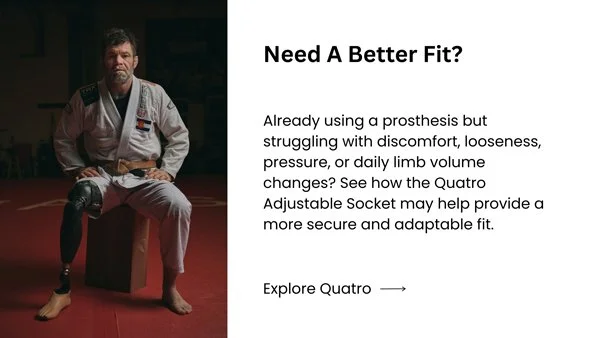
The Quatro Adjustable Socket is one example of Quorum’s custom, patented prosthetic technology. It is designed with three to four replaceable, adjustable panels and a Click dial system to help support targeted compression, comfort, and daily fit management.
-
Prosthetic sockets are typically custom-designed to match the user’s anatomy, clinical needs, and goals. Because the socket is the connection between the person and the prosthesis, proper fit is an important part of comfort, stability, and function.
-
The timeline can vary depending on the type of prosthesis, clinical evaluation, insurance authorization, fabrication needs, fittings, and adjustments. We will walk you through the expected process based on your specific situation.
-
Fit concerns should be addressed as soon as possible. Changes in comfort, pressure, skin irritation, or stability may mean an adjustment is needed. Quorum can evaluate the issue and recommend next steps.
-
Yes. Residual limb shape and volume can change due to healing, activity level, weight changes, fluid retention, temperature, and other factors. These changes can affect how a prosthetic socket fits throughout the day or over time.
-
The right prosthetic solution depends on your anatomy, mobility goals, activity level, lifestyle, medical needs, and personal preferences. A clinical evaluation helps determine which options may be appropriate.
-
Yes. If you already use a prosthesis but are experiencing fit issues, discomfort, instability, or changes in your needs, we can evaluate your current setup and discuss possible improvements or alternatives.
-
Adjustment needs vary from person to person. Some users may need changes during the initial fitting period, while others may need adjustments as their limb, activity level, or goals change over time.
-
Care instructions depend on your specific prosthetic components and socket design. In general, it is important to keep your prosthesis clean, monitor your skin, inspect components regularly, and contact your prosthetic team if something feels loose, uncomfortable, or unusual.
-
Stop and check the area as soon as possible. Skin irritation, redness, pressure marks, or pain can be signs that your socket fit needs attention. Contact your prosthetic care team for guidance before the issue worsens.
-
You can get started by contacting us to schedule a consultation. Our team will learn more about your needs, answer your questions, and guide you through the next steps in the prosthetic care process.